Product Overview
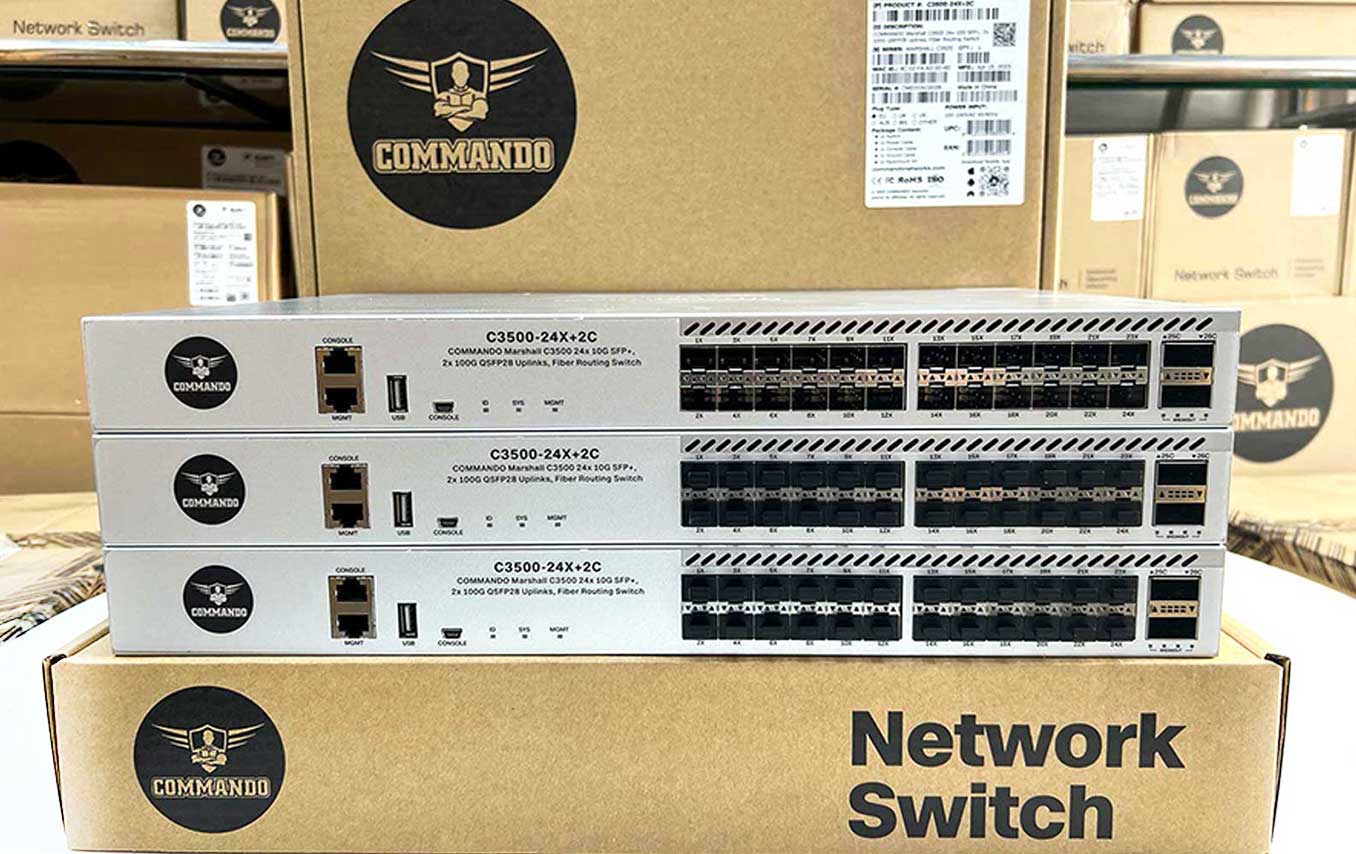
COMMANDO Marshall C3500 Series switches are L3+ Core and Data Center Series Routing Switches which are fully managed having 1G or 10G Fiber/ 1GE or 10GE copper Ethernet switchports along with fixed with Small Form-Factor Pluggable (SFP, SFP+, SFP28, QSFP+, QSFP28) and perpetual PoE/PoE+ or Non PoE models or 24/32 ports SFP+ models along with physical stacking up to 16 switches with recommended stack cables of 50cm. Perpetual PoE/PoE+ with PoE budget for 24 port switch 600W and 48 port switch 800W for PoE power with no power downtime for network resiliency and high availability, delivering robust performance and intelligent switching for growing networks. This series switches are easy to deploy, use, manage and designed exclusively for enterprise-class core and aggregation layer data center switches, specially built for Security, IoT, and Cloud networking needs of growing businesses, data centers and high-end campus networks comes with inbuilt dual power input AC as well as DC.
It has high performance 100G / 40G / 25G/ 10G / 1G/ 1GE switches designed based on COMMANDO’s sixth generation Ethernet switching technology with Carrier Grade high-performance which helps it to meet the requirement of Metro/Enterprise/Data Center/HCI networks. COMMANDO Marshall C3500 meets the requirements of next generation Enterprise, Data Center, Metro and HCI (Hyper-Converged Infrastructure) networks which includes VRRP, VRRP load balancing, BFD for VRRP, BFD for BGP/IS-IS/OSPF/Static route, MPLS L2 and L3 VPN, BFD for VXLAN, Segment Routing (SR), QoS Traffic classification based on Layer 2, Layer 3, Layer 4, and priority information Actions including ACL, CAR, and re-marking, Queue scheduling modes such as PQ, WFQ, and PQ+WRR, Congestion avoidance mechanisms, including WRED and tail drop, Traffic shaping, O&M Network-wide path detection, SNMPv1/v2c/v3, Zero Touch Provisioning (ZTP), 802.1x authentication, RADIUS and TACACS+ authentication for login, DoS, ARP, MAC address attacks, broadcast storms, heavy-traffic and ICMP attack defenses and Remote Network Monitoring (RMON) with high performance and scalability along with rich L3 features. It also supports VSF (Virtual Switching Framework) with strong multicast, high reliability network with comprehensive QoS and enhanced Security with abundant IPv6 Support.
It can be deployed in harsh environments to deliver hassle free mission-critical services for next-generation, high-performance core networking setup designed for data center networks and high-end campus networks. It also provides stable, reliable, and secure high-performance Layer 2, Layer 3 and data center switching capabilities to help build an elastic, virtualized, and high-quality network. VXLAN to build a non-blocking large Layer 2 network, which allows for large-scale VM migration and flexible service deployment. These switches support comprehensive virtualization capabilities along with data center service features can also be used for surveillance requirements.
The switches come with fixed uplink modules with speed 1, 10, 25, 40 and 100 Gigabit (SFP, SFP+, SFP28, QSFP+, QSFP28) Fiber Network Module as well as 1GE/10GE Copper Network Modules and are latest development of Gigabit Layer 3 Core and Data center Switch with up to 100G uplink, Intelligent managed Switches designed for networks requiring High performance, High port density, High uplink bandwidth, Flexibility, Fault Tolerance, and Advanced Software features for maximum Return on Investment (ROI). These switches have Security features, and advanced Quality of Service (QoS), ideal for all organizations considering reliable, affordable and advanced Core and Data center feature with CLI and Web managed, Advanced PoE/PoE+, Scripting capabilities and Layer 3 routing, Automatic MDIX and Auto-negotiation on all ports select the right transmission modes (half or full duplex) as well as data transmission for crossover or straight-through cables dynamically. It can save up to 58% of power consumption, making it an eco-friendly solution for your business network.
A stack system separates the control plane from the data plane. This eliminates the risk of single points of failure and greatly improves system reliability. The single virtual switch, enabling customers to have a single management plane and control plane for up to 768 access ports with full PoE/PoE+ capability, power and fan redundancy, stacking bandwidth up to 3456Gbps, Fixed uplinks, Layer 3 feature support, and cold patching for the digital workplace, these are optimized for today’s data center surveillance, mobile and IoT needs. Multiple switches up to 16 in a stack system are virtualized into one logical device, making it possible to build a scalable, easy to manage data center network platform.
These switches are powerful and flexible enough for users to deploy wireless access points, surveillance cameras, IP phones and other PoE/PoE+ supported devices over longer distance up to 250 meters. It provides easy device rack and wall-mounting, on boarding, configuration, monitoring, and troubleshooting. These fully managed switches can provide Layer 3 Core and Data Center features as well as supports IEEE 802.3af-compliant PoE (Power over Ethernet) and 802.3at-compliant PoE+ (Power over Ethernet plus). Each switchport is capable to deliver either 15.4 W PoE or 30 W PoE+ power on all ports. PoE/PoE+ capable models provide power across all access ports for wireless APs, security cameras, and other IoT devices with power budget 600W-800W. Designed for operational simplicity to lower total cost of ownership, they enable scalable, secure, and energy-efficient business operations with intelligent and automated services. These switches come with lifetime free software upgrades and patching to enhance features and supports patching, which provides fixes for critical bugs and security vulnerabilities between regular maintenance upgrades. This support allows customers to add new features and upgrades without having to pay a single dollar.
It offers robust QoS, to optimize traffic on your Business Network, these switches provide (Port-based/802.1p/DSCP) QoS to keep latency-sensitive video and voice traffic jitter-free moving smoothly. Additionally, port-based, tag-based VLAN, Voice VLANs can improve security and meet more network segmentation requirements. This series switches also have provisioning of QOS, Static routing, IPV6 features. Moreover, with its innovative energy-efficient technology, can save up to 58% of power consumption, making it an green-energy eco-friendly perfect solution for your business network.
Product Highlights
COMMANDO Marshall C3500 Series Managed Core L3+ capable routing switches are Carrier Grade high-performance switch which helps it to meet the requirement of Metro/Enterprise/Data Center/HCI networks.Full feature software Licensee free for Lifetime
Full feature software Licensee free for Lifetime
- Full featured without license installations: COMMANDO MarshallOS switches comes with inbuilt free for lifetime for across all model that provides you with an easier, faster, and more consistent experience across the COMMANDO portfolio and across your company for inbuilt all license installation.
- No Activation key required: No requirement of PAK (Product Activation Key) to activate L3+ and Data center features.
- Operational Flexibility: Free patching to enhance features for enhanced version of MarshallOS, with the objective of providing a free licensing solution that does not interrupt the operations of network.
- Limitless term period for consumption: For limitless time, permanent and without an expiration date and limitless term period software features can be used. You can consume all features for whatever period you like.
Higher serviceability and return on investment
- Lower CAPEX: Ensures network scalability and reduces investment in devices. Lowers Total Cost of Ownership with no license requirement (Lowers Capex).
- Lower OPEX: No licenses charges for L3+ and data center features for lifetime. No license fees (Lowers OpEx) lifetime free software upgrades and patching to enhance features and supports patching, which provides fixes for critical bugs and security vulnerabilities between regular maintenance upgrades.
- Dual input power Option: Dual input power AC as well as DC inbuilt So, unlike major mainstream brands have capability of dual power or RPS but originally it comes with single AC supply only. For DC power input you required to purchase very specific DC power modules and adapter as well as power cable. DC power supply with major mainstream brands cost extra money while in COMMANDO switches it is freely available and also this DC supply do not have specific requirement of cable and adapter for DC power input it comes with standard specification which is commonly used.
- Uninterrupted service: Inbuilt DC power supply can give uninterrupted power supply which is vital for mission critical network operation. No need to spend extra money for dual power supply AC as well DC and also no separate special DC Adapter and cable required to provide power via DC as well AC power input.
- Zero cost of switch maintenance: Lower CTO It can use one physical switch to implement multiple logical switches saves space in a data center equipment room and reduces the cost of device maintenance.
- VXLAN and EVPN: Enable Flexible Expansion Within and Across Data Centers.
- Supports Border Gateway Protocol: (2 bytes as well as 4 bytes AS numbers), Ethernet VPN (BGP-EVPN), which can run as the VXLAN control plane to simplify VXLAN deployment. BGP-EVPN triggers automatic VXLAN tunnel setup between virtual tunnel endpoints (VTEPs), removing the need for full mesh tunnel configuration. BGP-EVPN also reduces flooding of unknown traffic by advertising MAC routes on the control plane. With this protocol, large Layer 2 networks can be established for data centers.
- Use Open standard protocols: It is interoperable with devices from other vendors, enabling long-term network evolution.
- Supports centralized and distributed VXLAN deployment: Supports various VXLAN access modes, including QinQ access VXLAN and IPv6 over VXLAN. This allows for flexible customization of heterogeneous networks.
- EVPN and VXLAN: It can be used to set up Layer 2 interconnections between data centers, enabling active-active VXLAN deployment across data centers and conserving DCI link bandwidth.
- Supports IP packet fragmentation and reassembling: Enabling oversized IP packets to travel across a WAN network without limited by the MTU. The switch can also identify fragmented packets to seamlessly interconnect with routers.
- Supports VXLAN: It has mapping, implementing interconnection between multiple DCs at Layer 2, unified service provisioning and O&M, and inter-DC resource sharing.
- Multicast-capable Distributed Gateways: Implement On-demand Traffic Forwarding VXLAN supports Layer 3 multicast. A multicast-capable gateway that functions as the VTEP node greatly reduces traffic.
Data Center Features
- Support leading edge Data Center features: Priority Flow Control (PFC), ETC, VEPA, SPB, TRILL, FCoE, Explicit Congestion Notification (ECN) and Data Center TCP, etc.
- Support MLAG (Multi-Chassis Link Aggregation): It aggregate links across different devices. MLAG can build an Active-Active system to improve the reliability of the network links from single board grade to device grade. MLAG use a peer link between to devices to aggregate two devices and make them as one device logically. Ports of two different devices join the aggregate ports together and all port can transmit the data traffic. MLAG need to management the device respectively, but the configurations are easier than stacking, reboot is not required after MLAG is configured. Forwarding and configuring are processing on local device, in normal condition the traffic do not transmit trough the peer link, the bandwidth of peer link is not the bottleneck of the network, and the latency is low.
- Support overlay technology: It includes NVGRE/VXLAN/GENEVE etc. Overlay can make layer 2 packets across the layer 3 networks by using NVGRE/VXLAN/ GENEVE header to encapsulate the entire Ethernet packets. Overlay resolves the problem of MAC table size limitation in traditional layer2 networks, resolves the problem of VLAN id count limitation, and resolves the problem network dynamic adjustment which cannot achieve by VLAN/VPN. Use VXLAN for example, 24 bits VNI identifier can support at most 16777215 logic networks, layer 2 networks built by VXLAN can keep the same IP/MAC etc. when move the virtual machine.
- Supports RPC-API for SDN (Software Defined Network): SDN is a new architecture of network which can substantially simplify the management and maintenance by separating the control plane and data plane of the network.
HCI (Hyper-Converged Infrastructure)
- Supports 1GE/1G/10GE/10G/25G/40G/100G ports are suitable for HCI (Hyper-Converged Infrastructure) networks. Using 1GE/1G/10G Ports for management network and using 10GE/10G/25G/40G/100G ports for data traffic network. With the comprehensive inter-device link aggregation with LACP, MLAG, etc.
Varied Port Types
- 24GE/48GE PoE and Non PoE models, 24/32 SFP+ models along with Fixed uplink ports with stacking capacity up to 768 ports.
- Support varied management interfaces, includes RJ45 based Console & Management port, USB Console, USB 2.0 Storage port, Bluetooth 5.0 Console port & IEEE 802.11a/b/n (2T2R) 300Mbps Management port.
- Support Fixed Uplinks having capacity 1GE/10GE, 1G/10G/25G/40G/ 100G ports to meet bandwidth hungry network requirement in data centers with copper 1GE/10GE & fiber connectivity of SFP/SFP+/SFP28/QSFP+28 up to 100G modules.
Customized Profile for Different Deployment Scenarios
- The Flexible Table Management (FTM) technology offers multiple table size configuration profiles as optimized choices for different network scenarios. Support up to MAC Address Table Size 114688 entries. Support up to 56K IP routing table entries.
Overlays
- Customers can deploy overlay networks to provide Layer 2 adjacency for applications over Layer 3 fabrics.
- The overlay networks use VXLAN in the data plane and EVPN to program the overlays.
- The overlays can operate without a controller or can be orchestrated with a fabric management platform to provide L2/L3 overlay virtual networking and security for bare metal servers and virtual workloads.
High-performance IP routing
- Supports routing protocols which includes static route and dynamically learned route with protocols like Routing Information Protocol (RIP) version 1 and 2 and next generation (RIPng), Open Shortest Path First (OSPF) Version 2/3, Border Gateway Protocol Version 4 (BGPv4) with AS Number of 2 and 4 bytes, and Intermediate System-to-Intermediate System also supports load balancing and for constructing scalable LANs. Supports up to 20480 IPv4 direct routes and up to 57344 indirect routes along with 256 unicast ipv4 policy based routes & 1024 multicast ipv4 routes is supported by hardware with maximum performance.
- Protocol-Independent Multicast (PIM) for IP multicast routing is supported with direct route up to 2048, including PIM Sparse Mode (PIM SM), bidirectional PIM, and Source-Specific Multicast (SSM).
- IPv6 addressing and routing is supported along with monitoring and troubleshooting commands.
Multi protocol label switching (MPLS)
- L2 and L3 VPN with MPLS: It integrates multiple networks into a single MPLS domain.
- VPLS: VPLS (Virtual Private LAN Service) enables enterprises to link together their Ethernet-based LANs from multiple sites via the infrastructure provided by their service provider.
- EoMPLS: EoMPLS is a category of Any Transport over MPLS (AToM) to transport Layer 2 packets over an MPLS backbone.
- MPLS over GRE: L3VPN over GRE and VPLS over GRE, are supported to tunnel MPLS/VPLS packets over non-MPLS networks utilizing GRE tunneling.
- Support a broad set of MPLS features, including L3 VPN, IPv6 provider edge router (6PE, 6VPE), RSVP traffic engineering, and LDP to allow standards-based network segmentation and virtualization.
Inter-device Link Aggregation, High Efficiency and Reliability
- Support multi-chassis link aggregation group (M-LAG), which enables links of multiple switches to aggregate into one to implement device-level link backup. Switches in an M-LAG all work in active state to share traffic and back up each other, enhancing system reliability.
- Switches in an M-LAG can be upgraded independently. During the upgrade, other switches in the system take over traffic forwarding to ensure uninterrupted services.
- M-LAG supports dual-homing to Ethernet, VXLAN, and IP networks, allowing for flexible networking.
- Virtualization M-LAG VS (1:16 virtualization), Cluster Switch System (CSS).
Perpetual POE/PoE+
With Perpetual PoE/PoE+, no power downtime to connected PD devices. PD devices remains power ON even when any software process is not running on the switch. Provides non-stop PoE/PoE+ power and continue to provide power during configuration and reboot, the PDs will not lose power while reloading. The Perpetual POE provides uninterrupted power to connected powered device (PD) even when the switch is booting to make it highly available network without any interruptions.
Intelligent Ethernet OAM with Complete Network Fault Management and Performance Guarantee
With the IEEE802.1ag and ITU-T Y.1731 end-to-end OAM, Ethernet service providers can monitor the services, survey the end-to end performance and ensure the service quality match the agreement. The fault management technique includes CCM, LTM and LBM. Performance targets include measure for latency and jitter. It support remote management, network monitoring, network fault indication, remote loopback and MIB parameter retrieval according to the standard 802.3ah EFM.
High Reliability and Fault tolerance
- Powered by inbuilt dual input power supply modules with AC as well as DC.
- Fans support 3 Temperature Control Fan, front-to-back airflow design suits data center equipment rooms, and fan speed control as per surrounding conditions requirement greatly reduce power consumption.
- Support Real-time environment monitoring technology to detect the chipset temperature, status of fan and power, etc.
- Support LACP / VRRP / VARP / STP/RSTP/MSTP / Smart Link / BFD / ERPS / G.8031 / G.8032 / Load-Balancing, etc. to protect the network traffic all-around effectively.
L2 to L4 QoS Control
- Provides 13 hardware queues per-port (8 unicast queues, 4 multicast queues, and 1 monitor queue).
- Support multi-stage scheduling technology such as WDRR (Weighted Deficit Round Robin) / SP (Strict Priority) and TD (Tail Drop) / WRED (Weighted Random Early Detection) to prevent congestion.
- Traffic classification based on COS/DSCP (simple classification).
- Traffic classification based on ACL (complex classification), Traffic classification based on inner header of the tunnel packets.
- Queue scheduling with Remark the priority fields (COS/DSCP) of the packet based on ACL or Remark the priority fields (COS/DSCP) of the packet based on the Table.
- Flow redirection, Flow mirror with traffic policing based on direction (in/out) of Port, Traffic policing based on direction (in/out) of VLAN, Traffic policing based on direction (in/out) of flow, Traffic policing based on direction (in/out) of aggregated flow Queue based traffic shaping, and Port based traffic shaping.
- Supports scheduling like SP (Strict Priority) scheduling, WDRR (Weighted Deficit Round Robin) scheduling, SP+WDRR mixed scheduling, TD (Tail Drop) WRED (Weighted Random Early Detection).
- Packet counts and bytes statistics based on traffic classification, Packet counts, and bytes statistics based on the color after traffic, Forwarded and discarded packet counts and bytes statistics, ECN tags based on Tail Drop, ECN tags based on WRED
- Support flexible queue scheduling mechanism to do the shaping for queue or port traffic.
- Ingress and egress policer provide intelligent bandwidth monitoring, which support to adjust the granularity according to the port speed. Both srTCM (Single Rate Three Color Marker) and trTCM (Two Rate Three Color Marker) can be supported.
- Offers high bandwidth for Triple-Play services such as IPTV, video monitoring. The built-in QoS capabilities and flexible queuing technologies guarantee high quality of services.
Multicast
- Rich multicast protocol set (IGMP Snooping, IGMP v1/v2, PIM-SM) support up to 2K multicast groups and 4K logical replications per group. With MarshallOS software, IPTV service and multicast latency control are fully supported.
Security
- Supports subscriber-class /switch-class /network-class security control.
- IPv4 / IPv6 / MAC ACL can filter IPv4 / IPv6 / Non-IP packet respectively. Besides that, extended IPv4/IPv6 ACL which can match Layer2 / layer3 / layer4 information in one rule is available. The ACLs can apply to physical ports / VLAN / port group / VLAN group. The members of port group or VLAN group share a set of ACLs and save the TCAM resource.
- ARP Inspection and IP Source Guard features prevent network from malicious ARP attack.
- Support CPU Traffic Protection, Storm Control and CPU load optimization features.
- Support centralized 802.1x authentication feature to forbidden illegal user accessing network.
- MACsec encryption is supported using a built-in advanced Layer 2 encryption engine based on standard IEEE 802.1AE, 256-bit, and 128-bit Advanced Encryption Standard (AES) algorithms to secure all traffic communications.
Convenient Management features
- Supports RPC-API for SDN (Software Defined Network). SDN is a new architecture of network which can substantially simplify the management and maintenance by separating the control plane and data plane of the network.
- Support varied management interfaces, include console port / INBAND network ports / OUTBAND network port / Mini USB port.
- Support SNMP v1/v2/v3, Support CLI (Command Line Interface), web management, Telnet and FTP connection.
- Support OAM to make management more convenient and support SSH2.0, SSL, etc. to ensure security of management.
Perpetual POE/PoE+
With Perpetual PoE/PoE+, no power downtime to connected PD devices. PD devices remains power ON even when any software process is not running on the switch. Provides non-stop PoE/PoE+ power to all ports and continue to provide power during configuration and reboot, the PDs will not lose power while reloading. The Perpetual POE provides uninterrupted power to connected powered device (PD) even when the switch is booting to make it highly available network without any interruptions.
Support uninterrupted critical network infrastructure
It has dual power options with AC which protect from power failures. Dual power improves availability to 100% and also increases life of device. It also comes with Lighting surge thunder protection ±6KV. With this feature protect on cost and the impact to your business by losing these network devices and thus the users/servers connected to them.
System Design for Green and Energy Saving
Intelligent FAN adjustment and real-time power consumption monitoring technology are provided for the cost of maintenance redundancy and IEEE802.3az Energy Efficient Ethernet (EEE) specifies the signaling for minimal power consumption during times when data is not being transmitted. 802.3az supports reduced power usage that reduces switch power consumption during periods of low network traffic. It is also sometimes known as Green Ethernet which help to build a green and energy saving data center.
Carrier Grade High Performance long-life chip
Designed based on COMMANDO’s sixth generation Ethernet switching technology. COMMANDO Marshall C3500 Managed L3+ Core and Data Center Series Routing Switches are Carrier Grade high-performance switch which meets the requirement of Metro/Enterprise/Data Center/HCI networks.
Features and Benefits
High-speed Performance with dual input power with HCI (Hyper-Converged Infrastructure)
Supports fixed uplinks with 1GE/10GE copper, 1G/10G/25G/40G/100G Fiber ports with backward compatibility along with stacking capacity up to 768ports and dual power card are suitable for HCI (Hyper-Converged Infrastructure) networks. Using 1GE ports for management network and using 10GE/10G/25G/40G/100G ports for data traffic network. With the comprehensive inter-device link aggregation with LACP, MLAG, etc with 114688 entries MAC address tables, 72 MB Packet Buffer memory, 9600 bytes Jumbo Frames, IPv4/IPv6 with 20480 static routing entries and up to 56000 entries in routing table.
Data Center Features
VXLAN, EVPN, Ethernet VPN (BGP-EVPN) with automatic VXLAN tunnel setup between virtual tunnel endpoints (VTEPs), removing the need for full mesh tunnel configuration with QinQ access VXLAN, IPv6 over VXLAN, VXLAN mapping, along with unified service provisioning and O&M, and inter-DC resource sharing.
L3 Features
Supports static route, default route, dynamically learned route and dynamic routing protocol with protocols set like RIPv1, RIPv2, RIPng, OSPFv1/2/3, BGPv4, IS-IS and load balancing with VRRP. It also has PIM including PIM SM, bidirectional PIM, and Source-Specific Multicast (SSM). It also has QoS, ACLs (Port based/ IP based/ MAC Based), DHCP Server and Client, DHCP Snooping, DHCP Snooping option82 and 252, DHCP Relay. It supports L2 and L3 VPN with MPLS, VPLS, EoMPLS, and MPLS over GRE: L3 VPN over GRE and VPLS over GRE.
Watchdog Function
This ensures high availability which is used to protect a system from specific software or hardware failures that may cause the system to stop responding and self-recover from hanged state.
L2+/L2 Features
This series is having advance L2+/L2 features like Port aggregation up to 8 ports, VLAN, Voice VLAN, Spanning Tree (STP, RSTP, MST), GVRP, 802.1X authentication, centralized MAC authentication, Guest VLAN, RADIUS authentication, SSH 2.0, Port isolation, Port security, MAC address learning limit, IP Source guard, Dynamic ARP inspection, Preventing man-in-the-middle attacks and ARP DoS attacks, IP/Port/MAC binding. Flexible Software features provides wide range of Layer 2 functions like VLAN, Multicasting, and Quality of Service (QoS), Security.
Secure Networking
IEEE 802.1X port-based access control with surveillance VLAN, Port Security, Protected Port which also Prevent ARP Spoofing. L4/L3/L2 access control lists (ACLs) for granular network access control including 802.1x port authentication. ACL, L4 to L2 feature restricts access to sensitive network resources. DHCP Snooping ensures IP address allocation integrity by only allowing DHCP messages from trusted DHCP servers and dropping malformed DHCP messages with a port or MAC address mismatch. With DHCP Snooping binding and option82 and 252 enabled, it can combine dot1x and ARP. IP-MAC-Port-VID Binding, Port Security, Storm control which protect against broadcast storms. The switches support ARP attack and DoS attack prevention to safeguard the network.
Multicast
IGMP Snooping (v1, v2, v3), Multicast Listener Discovery (MLD) (v1/v2), Multicast VLAN Registration (MVR) designed for distribution of multicast traffic across segregated access networks which enables more efficient distribution of multicast streams in Layer 2 network.
QoS Features
Advanced QoS (Quality of Service) for traffic prioritization including port based, 802.1p and L4/L3/L2 DSCP based. L4/L3/L2 QoS optimize voice and video applications. Access Control List based, VLAN ID based IP precedence, COS and DSCP. Policy Based on Port & VLAN, Remark DSCP, COS/ 802.1p, Precedence, COS for SP, WRR for Scheduling and matching the IP fragmentation of message.
1G/1GE/10G/10GE/25G/40G/100G Backward Compatible Uplink
1G/1GE/10G/10GE/25G/40G/100G Backward Compatible Uplink supports high speed networking uplink requirement and reduces copper stacking cabling requirement and investment. Features like MLAG, LACP and LAGs and improves network backbone uplink stacking capability. It supports high-speed access to the network backbone or data center environment. This provides great resiliency, relieves congestion associated with bandwidth-intensive applications, and guarantees smooth hassle-free data transmission.
Stacking management
Stacking is a method of binding multiple switches so that they can act as a single switch. Stacking helps to configure multiple switches in such a way that they appear as a single switch with this group of switches showing the characteristics of a single switch but having the port capacity of the sum of the combined switches. A switch stack can be set of up to 16 switches connected through their uplink ports and only 50cm stack cables recommended. Stacking management with active and standby for stack control with auto numbering. Hot swap of units in stack to configure and manage switches in a stack as a single unit with a single IP address. The switch that controls the operation of the stack is the stack master. Switch Stack is a common technology used in network design, especially when large numbers of ports are required.
Easy Management
With familiar and popular Command Line interface (CLI), there is no need for engineers to be hired or additional resources to be spent on training and/or learning the switch CLI. Management is made easy via Web GUI or industry-standard Command Line Interface (CLI), with administration traffic protected via SSL or SSH encryption. SNMP (v1/v2c/v3) and RMON support enables the switch to be polled for valuable status information and allows it to send traps when abnormal events occur. This series is having highly reliable, conformance to international open standards, durable, serviceable, aesthetics, perceived quality, enhanced performance with larger range with copper cables and usability leads to value to money. Easy Management via lots of options like Web-based Graphical User Interface (WEBUI), Industry standard Command Line interface (CLI) via console, USB console port, telnet, SSH, HTTP, HTTPS and Putty.
Lifetime Free Software Licensing and Upgrades
MarshallOS Software license and Upgrades are free for lifetime. Users do not have to worry about switch license expiring and software getting outdated and purchasing license (which is constant concern and worry of few other brands). This series has improved HTTP base firmware upgrade as well as CLI based upgrades which are freely available to all users without any cost or license fee for lifetime. It is easy to install, configure, monitor, and troubleshoot. It significantly reduces cost of administration and Total Cost of Ownership (TCO).
Auto MDIX Capabilities
Auto sensing/Auto PoE/PoE+, 10M/100M/1GE/10GE ports with auto MDIX capabilities which also removes speed and duplex mismatches automatically as well as covers larger physical distance by auto adjustment of speed with copper pairs compared to other brands best switches.
Flexible Service Control
With various ACLs to flexibly control ports. It also supports Port-based VLAN assignment, MAC address-based VLAN assignment, Protocol-based VLAN assignment, and Network segment-based VLAN assignment. These secure and flexible VLAN assignment modes are used in networks where users move frequently. It also supports GARP VLAN Registration Protocol (GVRP), which dynamically distributes, registers, and propagates VLAN attributes to ensure correct VLAN configuration and reduce network administrator workloads. This series switches supports SSH v1/v2/v3, RMON, port-based traffic statistics, LLDP/LLDP-MED.
Compact Design with Flexibility of additional ports
The switches provide additional deployment flexibility, fiber connectivity with speed up to 100Gbps for each uplink as per model specifications for easy expansion of your networks. So, you can directly connect to a high-performance storage server or deploy a long-distance, Extremely high speed uplink in multiple of 100Gbps combining uplink by LAG or MLAG to another switch.
Perfect for Noise-Sensitive Environments
This series comes with temperature controlled fans along with Small form-factor, for silent operation. Perfect for noise sensitive environments. Fan based Switches have Temperature-based fan-speed up to 10000 rpm control combines accurate monitoring with minimized system acoustic noise. The Temperature Controlled Fans based switches also feature built-in smart fans that monitor and detect temperature changes, adjusting the fan speed for maximum efficiency. At lower temperatures, the fans run at a lower speed, reducing both the power consumption and noise output of the switch.
Zero Maintenance
Cost efficient switches, Cost of ownership is less compared to other products of same features along with zero maintenance. Maximum power reduction for ongoing operation which ultimately save energy and running cost.
Easy Debugging and Troubleshooting
Ping, Traceroute, SNMP, RMON, Web based real time Switch ports monitoring with Web GUI and CLI can easily troubleshoot any problem in network with various show and debug commands.
Longer Distance Coverage
State of art quality switches that can serve real time high-speed performance which covers longer physical distance up to 250 meters with copper pairs as compared to other Major brands having limitation of 100m.